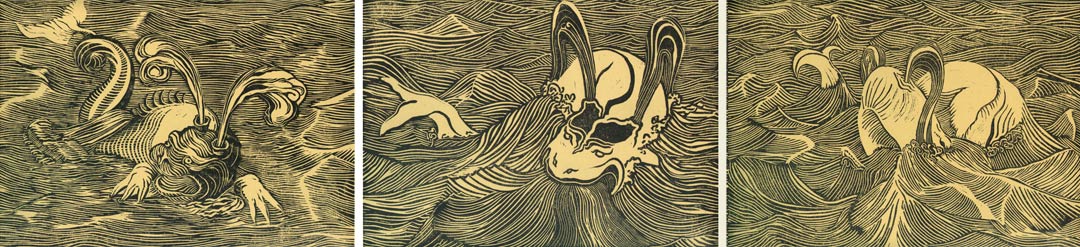
Balena, Woodcut on Rives BFK, 9" x 36", Vincent Colvin,

After many long hours at the bench hook I finally got this series completed! Or so I thought after waiting a week for the oil based ink to dry, I realize they are better proofs, time to go back in and make the transitions between the pieces smoother.

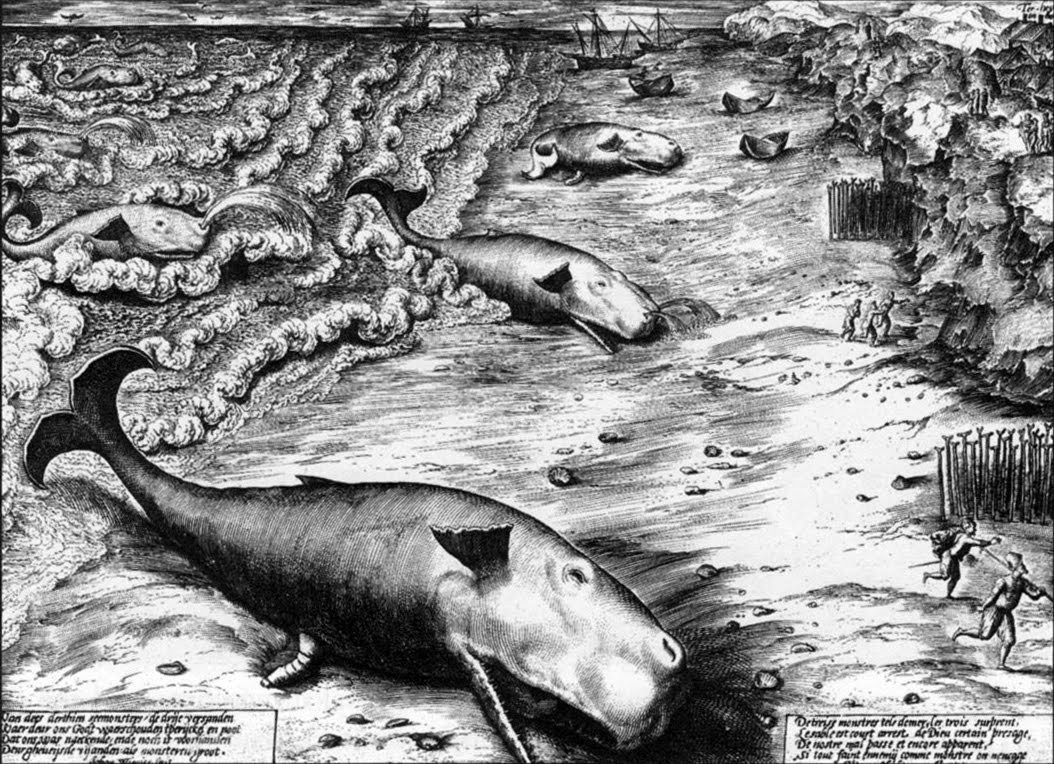
The three prints connect when you put them all next to one another. The pieces are inspired by imagery from early maps and engravings which depicted whales. The first image is based on the 1562 Map of America by Diego Gutierrez and the third from a 1577 engraving by Dutch artist Jan Wierix. The second is a merging of the two.

The verdict…. Woodcuts are awesome why have I not been doing this forever?

The woodcuts are cut with Japanese Moku Hanga woodblock tools and are hand printed with archival oil based ink. The prints are 9″ x 12″ each and 9″ x 36″ together. 4 sets of proofs in varying paper colors gray, light grey, cream, and the tan in these pics, on Rives BFK, and Somerset. Proofs are $25 each or $60 for the set. Visit my frame section and you could get a whole set maple framed, float mounted and ready to hang for an extra $150. To frame one print would be an extra $90. Fill the form out at the bottom of the page to order!

Final edition will be around $50 each or $120 for the set, also in varying paper colors on Rives BFK, perhaps some Chine-collé also.

Go back

Your message has been sent

Warning
Warning
Warning
Warning
Warning
Warning

Warning.

My newest painting just took a first place award at Atelier6000’s Feb. show Survey: Charts, Maps, Ledgers, Navigation.

My new series is about the final voyage of the whaleship Essex and its demise by ramming of an angry sperm whale leading to a harrowing 89 day, 2500 mile drift by whaleboat. Accounts from the few survivors have inspired sections of the whale attack in Melville’s, Moby Dick, and cannibalism in Edgar Allen Poe’s Narrative of Author Gordon Pym.

To me the voyage and tragedy represent a different era of American history. One that is built primarily on the quest for whale oil. Aside from the obvious romanticism of man at sea and the hardships thereof, the dubious task of taking down so large a mammal by hand relates humankinds ability to willingly enter into stupendous circumstances and risk everything. Harpooning a whale could take the better part of the day, with the whole whaleboat team rowing for miles upon miles to kill the whale and then haul it back to the boat for processing. That of course is if the whale didn’t rend their boat to splinters and send them all awash with a flick of its tail. Whaling was a primal enterprise and truly, few lines of work were as dangerous or as grizzly. These whale crews were also explorers, escaped convicts and slaves, outcasts, and men searching for themselves at sea. Their trade put them not only at risk of the elements, but presented enormous strain on their bodies, psyche, and thus their futures.

My series is not about glorifying the hunt or the killing of these whales, but it is about the idea of setting yourself adrift and truly pursuing something. I am interested in thinking about what these people experienced not in the eye of the whale or moment of the hunt, but in the world and sea around them as they drift the vast oceans and brave the unknown and volatile environment so far from the comforts of land. The pieces focus on place, in fact specific points on the map, and distinct moments as I see them through the eyes of those who may have traveled before me. They are not based on photographs and internet queries, but narratives and course plotting’s of travels past and of ideas of an invented ocean that perhaps my history as a human knows better than my own eyes.

This series is still being built and the ideas around the pieces must to have room to grow and evolve, but for now this is the path I have laid out to navigate.

42°N, 66°W - Oil and Encaustic on Formed Steel - 12" x 12"

40°N, 70°W - Oil and Encaustic on Formed Steel - 12" x 12"


These are the first in a series of paintings based on the route of the whale ship Essex before its disastrous sinking by an aggressive sperm whale off the western coast of South America. If you have google earth check out this virtual tour of their path. I made a quick video of how the supports were made for these two new paintings.

(Couldn’t resist those cheesy apple sound bites!)


The Specimen


So I was out watering the garden today when I heard a loud rustling in the grass. To my surprise a wasp was going to town on a large white moth with black spots. I rushed in for my camera and tripod and captured the 5+ minute battle (massacre) on tape, here it is condensed for your study! I am trying to find out if the wasp was merely after a late Tuesday breakfast or if it was trying to find a home for its little wasplets. I identified the moth as a Leopard Moth, male due to its yellow banding, and the wasp I believe is just a common wasp, which I think are not parasitic. I posted it to “Ask a Biologist” to see if they can give me the ringside details. In certain moments it looks like the wasp is stinging the moth, in another about half way through the video the wasp goes to the moths underside and begins to chew it in half. In any case, I kept the moth, post mortem and post wasp snacking, for study to see if anything occurs. I am certainly glad that wasps are not big enough to eye me up for lunch.

-Photo credit: Michelle Bright


Last week, Michelle and I went to a beach below the Town Lake Dam on the Colorado River. She was photographing the refraction of light in water in relation to depth for a project about hot springs.

So I set about looking for neat objects and stumbled on a lime stone fossil of what I believe is an Ammonite from some 251 – 65 million years ago! Based on its shape I thought it was a ancestor of the Nautilus, turns out its not. Its one of the earliest cephalopods in the phylum Mollusca,who’s lineage is now extinct. Needless to say, I spent the next hour or so scouring for more fossils. Alas, I was only to find patches of crumbling limestone with the occasional partial shell of some tasty clam of the past. Nothing to warrant exhuming from its rocky confines.

Below are a few pictures of the fossil after I found it and after I cleaned it out only to discover more rounded sawtooth ridges which helped me identify its likely time of existence.

The ridges are called sutures. Read the description below and pick which one you think it is, if enough people agree than we probably picked the right one!

Three major types of suture patterns in Ammonoidea have been noted.

Suture patterns:

  • Goniatitic – numerous undivided lobes and saddles; typically 8 lobes around the conch. This pattern is characteristic of the Paleozoic ammonoids.
  • Ceratitic – lobes have subdivided tips, giving them a saw-toothed appearance, and rounded undivided saddles. This suture pattern is characteristic of Triassic ammonoids and appears again in the Cretaceous “pseudoceratites.”
  • Ammonitic – lobes and saddles are much subdivided (fluted); subdivisions are usually rounded instead of saw-toothed. Ammonoids of this type are the most important species from a biostratigraphical point of view. This suture type is characteristic of Jurassic and Cretaceous ammonoids but extends back all the way to the Permian.

Post your guesses!!

This slideshow requires JavaScript.

Back in July, during my month long stay in VA I took up wood cutting. Since that time I have been working on a series of prints that are based off of 1592 spanish map engravings of sea monsters. Through the series I’ll be progressively cutting prints to look more and more like what creatures those bewildering 1592 sea monsters might actually be. The pictures above are all working proofs.

I am also working on a collection of small prints that I am creating En plein air of different locations around the Austin area. My first was Krause springs, working vigorously for an hour on site and enjoying some cold water swimming! You can see it in the pictures as the smaller print in the top right corner. This collection will either be bound as a book or possibly printed as one large print made up of however many blocks I decide is enough.

So far it has been a lot of fun and I am learning wood cutting fast. I am a bit disappointed that while I learned a lot from Dan Miller, that I was too busy painting and etching during graduate school to take advantage of his woodcut classes. Anyway, I am enjoying the process now and its fun to teach yourself something new after 6+ years of art schooling.

These are two recent absract seascapes. They are currently on view at the DCAC in Adams Morgan, DC until October 10th for their “Elements: State of Matter Show”.

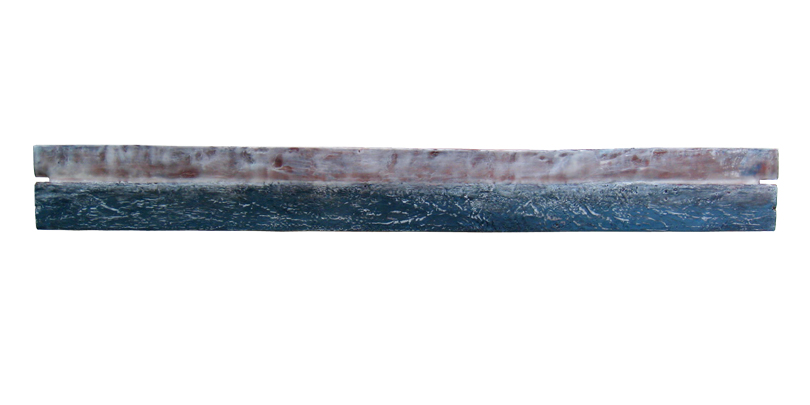
Medias - 2010 - 55" x 6" Encaustic on Manipulated Found Wood

Forgotten - 26" x 8" - 2010 - Encaustic on Found Wood

Here is what Pam Rogers, the gallery’s curator had to say about my work at the show:

“Vincent has taken the encaustic process to a new place with his abstracted panels. Vincent explores his interest in the “spaces that are tangible here below our own horizon.” This desire is often expressed in imagery suggestive of the ocean and its allure. It is the unknown aspect that makes Vincent’s work so compelling; the shapes and colors with soft welcoming edges suggest something to the viewer that cannot quite be immediately identified. The smaller more intimate pieces embrace the concept of mystery and the unknown. Vincent has enveloped these sumptuous little encaustic works in velvety delicate layers to convey water. Yet we know there is something just below the surface. His subtle play with color, creates strong powerful shapes that bridge the realm between two and three dimensional work. While the wax medium that Vincent manipulates is seductive in its own right, it is clearly just a vehicle that he uses to invite the viewer into his personal aquatic works.” – Pam Rogers, Artist and Curator

Bonus!!!! Cool link :  China Deep Sea Tour